
When people who have a tendency to stretch the truth tell me I need to do something, I like to learn more about their incentives before believing them, even when they’re successful CEOs or billionaires. Tech CEOs and billionaires have been breathlessly preaching the necessity of AI in every facet of life, including legal practice. We’ve heard tropes like “you won’t lose your job to AI, but rather to someone who uses AI.” Some have gone further, calling it “insane” not to use AI.
That’s like the CEO of Dunkin Donuts telling everyone they need to eat multiple mediocre donuts every day. Of course he wants you eating donuts. He sells donuts.
Why they need “everyone” to use AI
Software developers don’t need convincing. They’re already using AI and have seen how it can improve productivity on certain tasks. AI is particularly well suited to software development because code can be compiled, tested, and verified programmatically—if the code works, it works.
But there aren’t enough developers and tech enthusiasts in the world for AI companies to recoup their massive infrastructure spending. To get anywhere close, they need to convince everyone that AI isn’t just powerful or even transformative, but that it’s a necessity. I think this is why an AI billionaire would say something as performatively stupid as “I can’t imagine raising a child without ChatGPT.” They need you to believe that your career, and indeed societal progress—including your career as a legal professional—depends on AI adoption.
Don’t believe them.
You don’t have to use AI
I’ve argued before that AI deployment in legal practice requires a high degree of care and introspection. In some cases, I explicitly recommend against deploying AI because of what I call the verifiability bottleneck—the gap between AI’s output and your ability to confirm that output is correct. In software development, you can run the code. In legal work, verifying a contract clause, a case citation, or a regulatory interpretation often requires human judgment and the same expertise the AI was supposed to save you from needing.
But I keep coming back to this: even if your job were a perfect fit for AI, you still don’t need to use it. If you’re good at your work, if you provide value through it, and you find meaning in doing it, why automate yourself just because you could?
AI aims to remove humans from the equation. There are places where that is fine; for example, no one mourns the loss of manual document numbering. But in the face of AI, I think we should double down on what makes us human. Work that requires judgment makes us human. Creating value for clients makes us human. We shouldn’t build automations just because they’re possible. We should build them because they’re necessary.
Do not automate work that you value, excel at, or that strengthens client relationships.
The FOMO trap (and a better alternative)
A lot of law firms pursue what I’d call a FOMO-first approach to AI. They hear about the latest AI tool, they see a competitor using it, and they rush to adopt it without a clear understanding of how it will benefit their practice. The result is wasted time, wasted budget, and sometimes, real security exposure.
Others fall into a related trap that I call the solutions-first approach. An AI vendor shows up with a shiny product, the firm deploys it, and only then do people start looking for problems it might solve. This is also a fool’s errand. You wouldn’t buy an expensive bulldozer and then wander around looking for something to do with it.
A better approach is a problem-first approach. You start by identifying a genuine problem, a friction point in your practice. Then, you ask: is AI the right tool for this? If yes, what kind? And only then do you deploy a targeted and scoped solution, with guardrails appropriate to the sensitivity of the work. You don’t just deploy the largest, most powerful LLM you can find. In many cases, this is like buying a bulldozer to plant a vegetable garden in your backyard.
A simple filter for AI deployment decisions
Not every problem demands an AI solution, even if one exists. The flowchart below illustrates how I think about it.
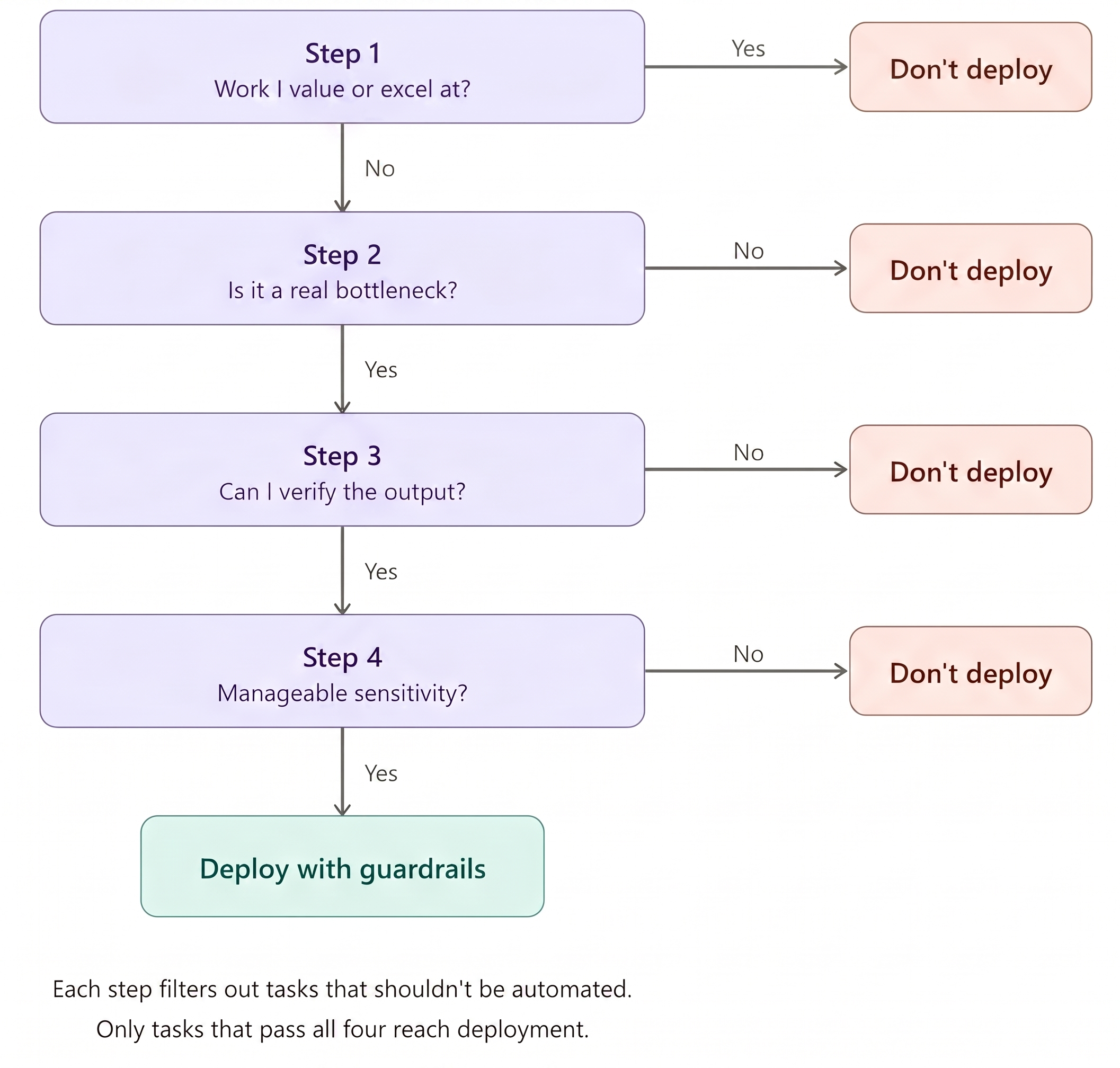
Step 1: Is this work I value, excel at, or that deepens client relationships? If yes, don’t automate it. This is your competitive advantage as a human professional.
Step 2: Is it a real bottleneck? Not every annoyance is worth solving with new technology. If the task takes five minutes a week, an AI tool with its own learning curve and risk profile isn’t worth the tradeoff. Look for tasks that are genuinely high-friction, repetitive, and low in professional judgment.
Step 3: Can I verify the output? Most firms skip this question. If you can’t reliably check whether the AI got it right, or if checking takes as long as doing the work yourself, AI creates risk without saving time. The verifiability bottleneck is real, and it’s where most legal AI deployments quietly fail.
Step 4: What’s the privacy and sensitivity exposure? What data touches this workflow (e.g., client names, case strategies, privileged communications)? The more sensitive the data, the higher the bar for AI vendor due diligence and risk assessment; the stronger the case for local-first or air-gapped solutions. AI compliance in legal practice is already a minefield; don’t make it worse with unnecessary deployments.
If the task clears all four filters—low personal value, high friction, verifiable output, manageable sensitivity—then you’ve found a good candidate for AI deployment. Everything else is a donut you don’t need to eat.
The cost of getting this wrong
Firms that deploy AI thoughtfully will spend less, expose fewer client confidences, and avoid the embarrassing (and increasingly common) spectacle of submitting AI-hallucinated citations to a court. They’ll also build trust, which is harder to quantify but more durable. Clients increasingly want to know how their data is handled. Having a defensible, privacy-aware AI deployment is increasingly a differentiator and not an overhead.
Firms that chase every new tool without a framework will keep hemorrhaging budget into solutions nobody asked for, while quietly accumulating unmeasured risk. And when something goes wrong—a data exposure, a hallucinated filing, a vendor breach—they will discover that “everyone else was using it too” is not a defense their malpractice carrier will accept.